Moving or Consolidating Offices: The ICT Decisions to Settle Before You Sign the Lease

The Decisions That Get Made Too Late
Office moves and consolidations are usually led by property, finance and the leadership team. The building is chosen for location, space and cost, the heads of terms are agreed, and IT is brought in once the lease is close to signature, or after it.
By then, several of the decisions that shape the ICT project have already been made by default. The connectivity options, the space for a comms room, the condition of the existing cabling and the obligations at the end of the lease are all fixed by the building and the lease, not by the fit out.
None of these are reasons to reject a good building. They are reasons to ask the right questions early, while there is still time to plan around the answers or negotiate them.
Connectivity Has the Longest Lead Time
The single most common cause of a delayed move is connectivity. Dedicated business circuits such as leased lines are not switched on like a broadband connection. They are designed, surveyed and often built, and UK providers commonly quote lead times measured in months rather than weeks. Where new ducting, wayleaves from landlords or neighbouring owners, or local authority permits are needed, they can take longer.
Before signing, it is worth establishing which carriers already serve the building, whether there is existing duct capacity into it, whether the landlord will grant wayleaves promptly, and whether diverse routes are possible if resilience matters to the business. Ordering circuits as early as the lease allows is usually the most valuable single action in the whole programme.
The Comms Room Is a Building Decision
Where the comms room goes, how big it is and what it can support are constrained by the building. Power capacity, cooling, floor loading, access for equipment, security and proximity to risers are all harder to change after the lease is agreed.
It is worth asking early whether there is a suitable space, whether it can be cooled adequately for the equipment you plan to run, whether the landlord permits the necessary works, and whether the routes from the comms room to each floor are practical. If the answer to any of these is uncertain, a short technical survey before signing is far cheaper than a redesign after it.
Existing Cabling: Asset or Liability?
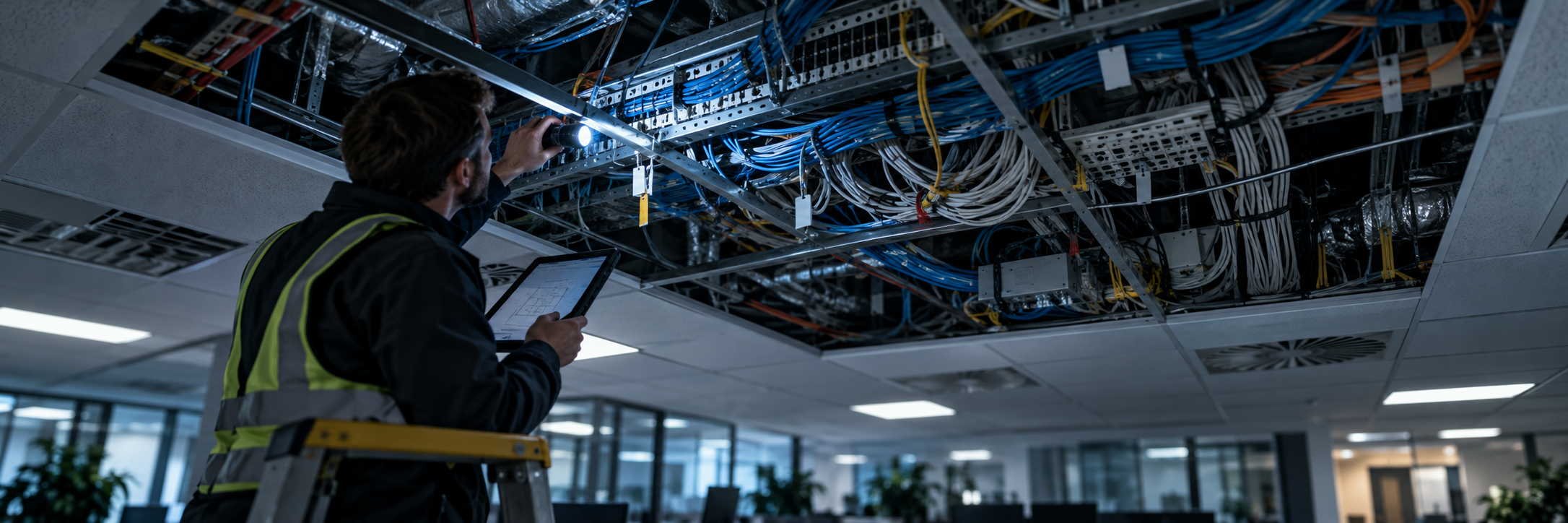
Many buildings come with cabling left by a previous tenant. It can look like a saving. Sometimes it is, but only if it is the right category for what you intend to run, properly installed, tested and documented.
Where the history is unknown, existing cabling needs to be surveyed and tested before any decisions are made. A building with a well documented recent installation is a genuine advantage. A building with several generations of undocumented cable in the void is a project in its own right, and it is much better to know that before the lease is signed than during the fit out.
Landlord Consents and End of Lease Obligations
Most ICT works in a leased building need the landlord's consent, particularly anything that affects the structure, the risers, fire stopping or shared services. Consent processes take time, so it helps to understand what will be needed and how long the landlord typically takes.
The end of the lease matters just as much as the start. Many leases require the tenant to reinstate the space, which can include removing the cabling and equipment installed during the tenancy. That is a cost that falls years later, but it is set now. Understanding the reinstatement obligations, and negotiating them where possible, is part of the ICT decision, not only the legal one.
Consolidation Brings Its Own Questions
When several offices are being brought into one, the ICT picture is usually more complicated than a straightforward move. Each site may have different networks, different standards and different suppliers. The consolidated office needs to support the combined headcount, often with more meeting rooms, more wireless demand and more collaboration technology than any of the original sites.
Consolidation is also the best opportunity to standardise. Agreeing one set of standards for cabling, wireless, security and documentation, and applying it to the new space, makes every future change simpler. It is much harder to introduce consistency later.
A Short List to Work Through Before Signing
Which carriers serve the building, and what are the realistic lead times for the circuits you need?
Is there a suitable comms room location, with adequate power, cooling and access?
What cabling is already installed, and has it been surveyed and tested?
What landlord consents will the ICT works need, and how long do they typically take?
What are the reinstatement obligations at the end of the lease?
Who in the business owns the ICT workstream, and when will they be involved in the property decision?
A Final Thought
The most successful office moves treat ICT as part of the property decision rather than a task that follows it. A few questions asked before signing can save months of delay and significant cost later.
iCobus supports office moves, consolidations and fit outs across the UK and Europe, from pre-lease technical surveys through to cabling, installation and full project delivery through our managed services. If a move is on the horizon, our team is happy to talk through the ICT questions before the lease is agreed.