
What's in Your Ceiling Void? The Case for a Cabling Audit Before It Becomes a Problem
The Infrastructure Nobody Looks At
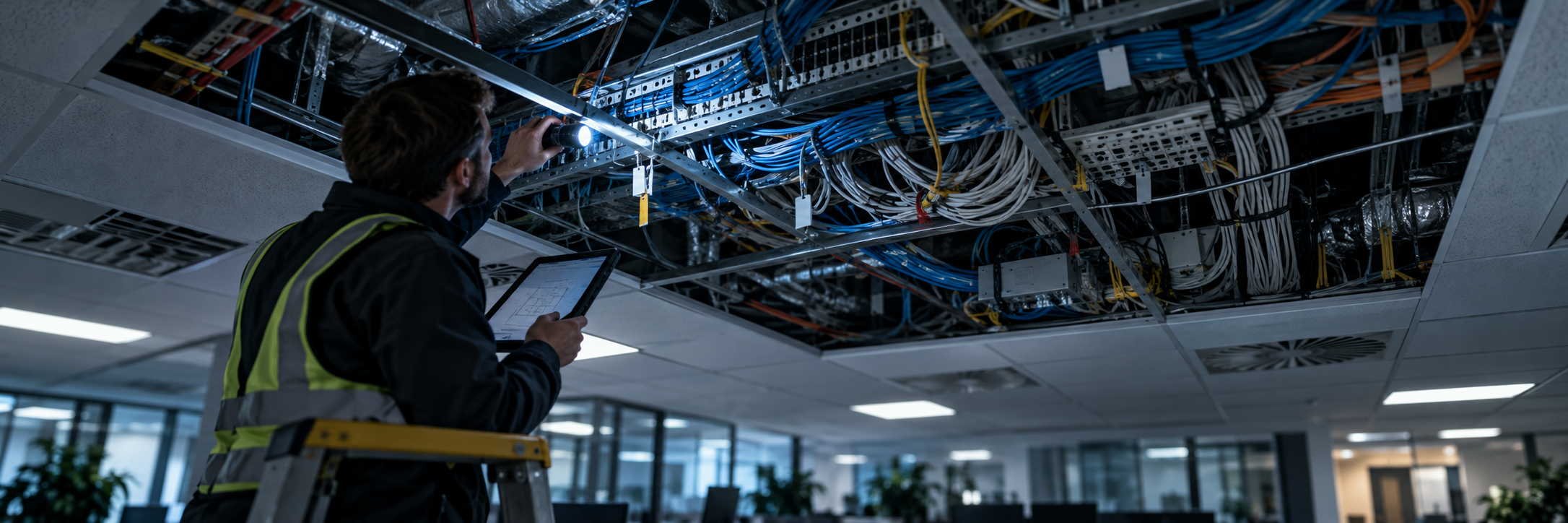
Every office has a layer of infrastructure that almost nobody in the business has seen. Above the ceiling tiles, under the raised floor and up the risers sits the cabling that every device, phone, camera and access point depends on.
In most buildings, that layer has been added to for years by different contractors, for different tenants, to different standards. Cables installed for a previous fit out are still there. Links that were moved during a reorganisation were never relabelled. Records that were accurate at handover have drifted a little with every change since.
None of this is visible while things work. It becomes visible when something goes wrong, when an upgrade is being planned, or when someone needs to know what is actually installed and discovers that nobody can say with confidence.
What an Audit Typically Finds
The findings vary by building, but a few patterns come up again and again.
Redundant cable. Cables that no longer serve anything are rarely removed, because removing them takes time and nobody is sure which ones are safe to cut. Over several fit outs they build up in the void, in containment and in risers.
Records that do not match reality. Drawings and schedules show what was intended, or what was true years ago. Outlet numbers, patch panel labels and the documentation disagree, so every change starts with detective work.
Mixed generations of cabling. Different floors, or different parts of the same floor, carry different categories of cable, installed at different times. The network is only as capable as the weakest link that a critical device happens to be on.
Containment that has been overloaded. Trays and baskets filled well beyond what they were designed for, cables resting on ceiling grids or other services, and fire stopping that was disturbed when cables were added and not reinstated.
Unknown ownership. Cabling belonging to former tenants, landlords, security contractors and telecoms providers, sharing the same routes with no clear record of who is responsible for what.
Why Leaving It Alone Costs More Than It Seems
The cost of an undocumented installation rarely appears as a single line. It appears in the time every move, add or change takes, because engineers have to trace and test before they can work. It appears in outages caused by someone disconnecting the wrong link. It appears in upgrade projects that overrun because the survey happens during the work instead of before it.
There is also a safety dimension. Redundant cable adds combustible material to a building, and cables installed over many years may not reflect the fire performance requirements that apply to telecoms cabling today. Since the Construction Products Regulation took full effect for cables in 2017, cables have been classified by their reaction to fire, and BS 6701 was amended the same year to set minimum classes for installed telecoms cabling. Exactly how those requirements apply to a given building is a question for a qualified specialist, but it is difficult to answer at all without knowing what is installed.
Finally, there is the question of the next upgrade. New wireless, security and smart building systems all lean on the cabling layer. Planning them on top of infrastructure you cannot describe is where budgets and programmes tend to go wrong.
What a Proper Audit Involves
A useful audit is more than a walk round with a torch. At minimum it should cover a physical survey of the main routes, containment, comms rooms and risers, a sample or full test of the installed links to establish what they can actually support, a reconciliation of labels and records against what is found, identification of redundant cable and of any obvious containment or fire stopping concerns, and a clear record of what is installed, delivered in a form your team and future contractors can use.
The output should end with recommendations, not just findings. Which links can be kept, which should be replaced, what can be safely removed, and in what order the work makes sense given the business's plans.
What to Settle Before You Commission One
A few decisions make the difference between an audit that is useful and one that sits in a folder.
Be clear about the purpose. An audit ahead of a wireless upgrade, an audit ahead of a lease event and an audit to support a fire safety review will each prioritise different things.
Agree the scope of testing. A full test of every link gives certainty but takes longer. A representative sample may be enough to make decisions, as long as everyone understands what it does and does not prove.
Decide what format the records should take and who will keep them current. An accurate record that nobody maintains will drift again within a couple of years.
Involve facilities and IT together. The cabling layer sits between both, and most of the problems described here exist because neither team fully owned it.
A Final Thought
The cabling above your ceiling is one of the few assets in the building that every system depends on and almost nobody manages actively. An audit will not make it glamorous, but it turns an unknown into something you can plan around, and it usually pays for itself the first time a project does not have to start with guesswork.
iCobus delivers structured cabling and ICT infrastructure projects across the UK and Europe, from surveys and audits through to remediation and upgrades, with the technical depth of a specialist subcontractor. If you would like a clear picture of what is installed in your buildings, our team is happy to talk it through.