
Europe's Data Centre Map Is Getting Wider: The Delivery Outlook for 2026 to 2028
A Market That Has Doubled, and Is Not Finished
Last year we mapped the growth of Europe's data centre markets in a bar chart race that turned out to be one of our most watched posts. A year on, the picture has moved quickly enough that it was worth doing again, properly, with the latest published data.
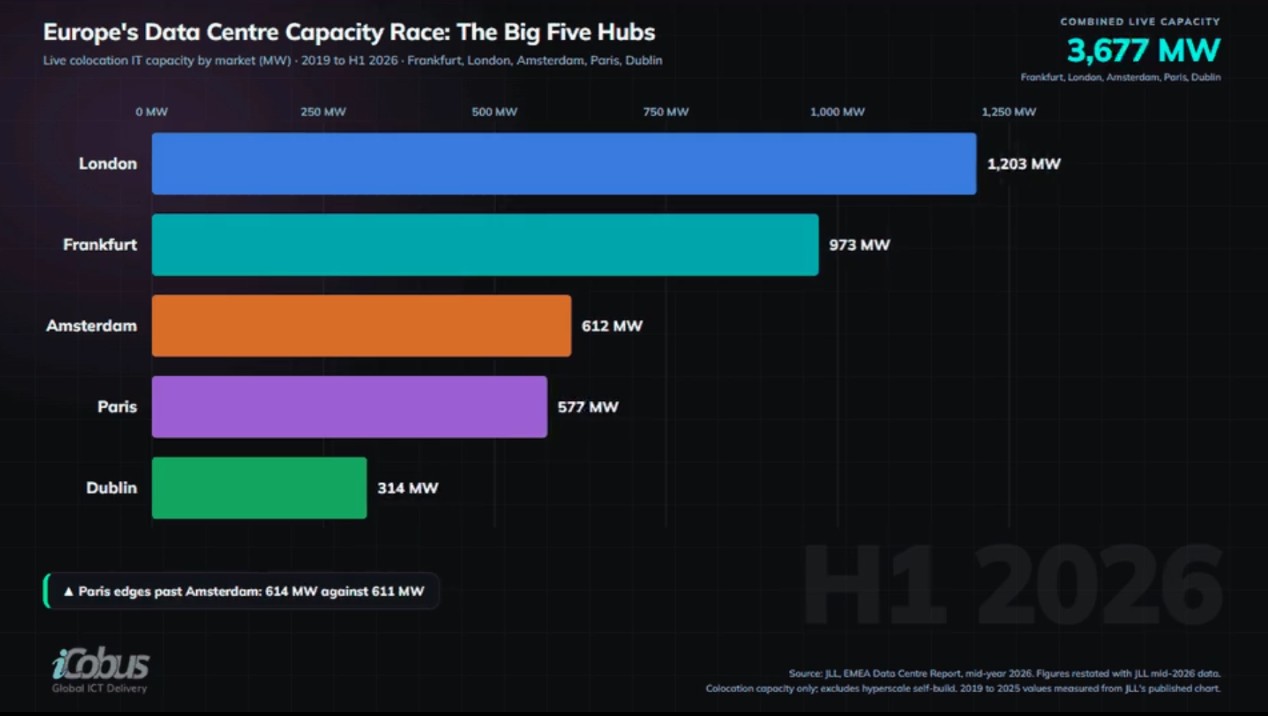
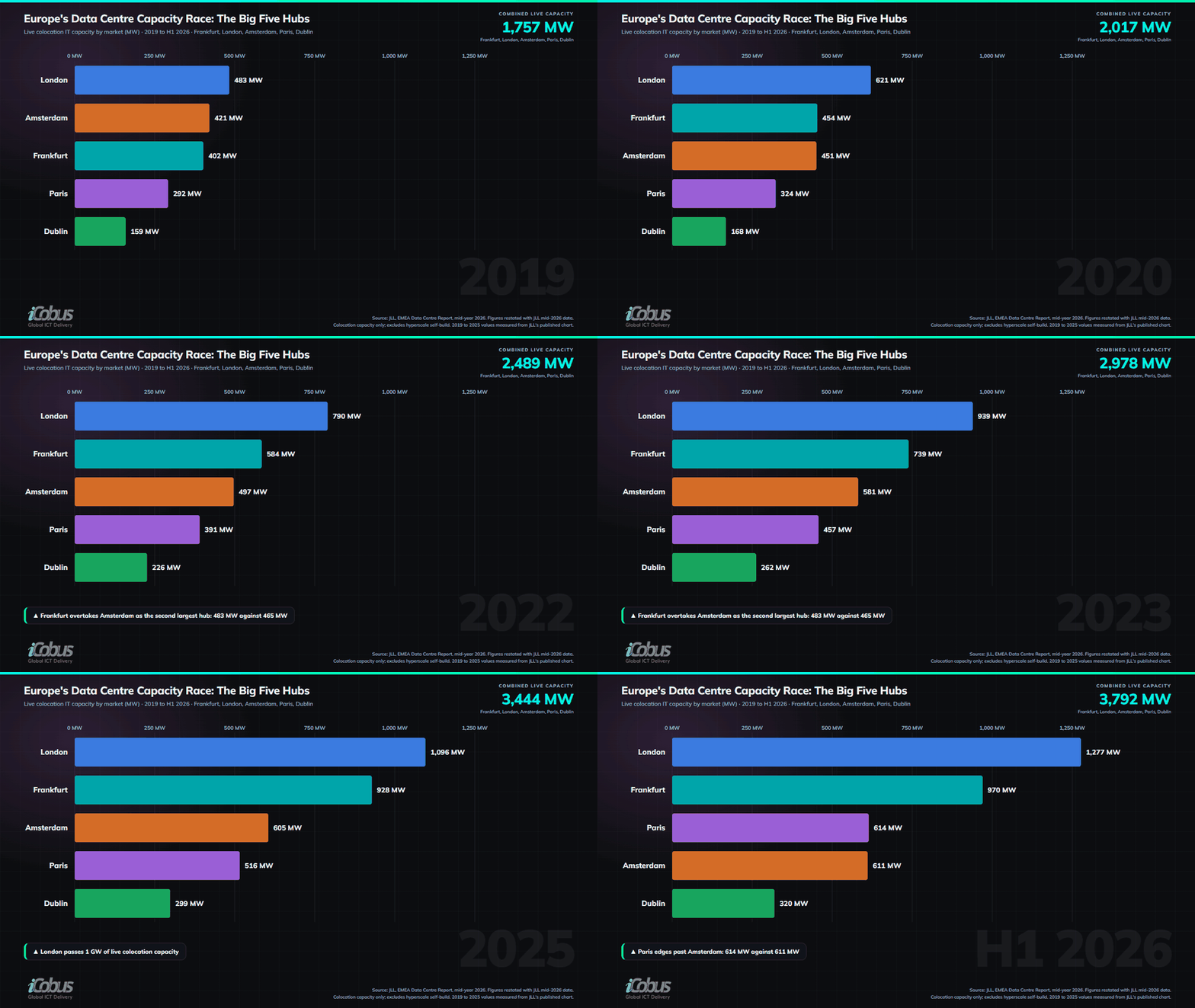
The headline is simple. Across Europe's five largest hubs, Frankfurt, London, Amsterdam, Paris and Dublin (known together as FLAP-D), live colocation capacity grew from about 1.8 GW in 2019 to 3.8 GW by the middle of 2026, according to JLL's mid-year EMEA Data Centre Report. That is more than a doubling in seven years.
The more interesting story sits underneath it: where the next wave of capacity is going, how tight the core markets have become, and what that means for the teams who have to build it. We have pulled all of it into a free report, the European Data Centre Delivery Outlook 2026 to 2028, and this article walks through the main findings.
A note on the figures. Our 2025 article used estimates for 2024 and 2025. Those figures are now restated with JLL's mid-2026 data, which covers every year from 2019.
The Big Five: How the Rankings Have Shifted
London remains Europe's largest market. It passed 1 GW of live colocation capacity in 2024 and reached 1,277 MW by mid-2026.
Frankfurt is the market that has changed position most. It overtook Amsterdam in 2021 and has more than doubled since 2019, to 970 MW. JLL reports that it delivered a record 135 MW of new supply in 2025, and still saw demand outstrip it.
Paris was the delivery story of the first half of 2026. It brought 72.5 MW online in six months, more than any other FLAP-D market and already ahead of its full-year forecast, and edged past Amsterdam: 614 MW against 611 MW. JLL links the growth to France's power availability and to sovereign cloud and AI demand turning into physical delivery.
Amsterdam has grown slowly since planning controls limited large new developments, while Dublin has doubled to 320 MW despite long-running constraints on grid connections.
Where the Next Wave Is Landing
The five hubs are still growing, but a rising share of new capacity is being built elsewhere. In the second quarter of 2026, 63% of the new data centre supply delivered across Europe was outside FLAP-D, according to CBRE, and markets outside the big five accounted for 55% of take-up.
The sites themselves are moving further out. JLL calculates that hyperscale campuses delivered between 2022 and 2025 sat an average of 46 km from a hub city. For the 2026 to 2028 pipeline, the figure is 175 km. Greenfield land rises from 8% to 39% of new supply over the same periods.
The reason, in both firms' analysis, is power. Grid connection queues in the core markets stretch beyond 2030, so capacity is following the places where power can be secured. Outside FLAP-D, JLL's figures put Milan at 230 MW of live capacity, Madrid and Oslo at 165 MW each, Warsaw at 150 MW, Copenhagen at 142 MW, Berlin at 140 MW and Stockholm at 91 MW. JLL expects Milan, Iberia and the Nordics to be treated as tier-one markets within the next cycle.
The Pipeline to 2028
Behind today's capacity sits a substantial pipeline. In FLAP-D alone, JLL counts 1.4 GW under construction and a further 2 GW planned, close to the size of the whole market today. Around 74% of the capacity under construction is already pre-let. Across EMEA, Cushman and Wakefield counts 3.8 GW under construction and 14.5 GW planned, against 12.1 GW operational.
CBRE forecasts total European supply, including hyperscale self-build campuses, to reach 13 GW by the end of 2026, a rise of 20% on 2025. It also expects more supply to be delivered in Frankfurt in 2027 and 2028 than in Amsterdam and Dublin combined, and expects Frankfurt eventually to overtake London as Europe's leading colocation market.
AI is adding a new layer of demand. CBRE reports that colocation capacity signed for AI purposes in the first half of 2026 reached 420 MW, up from 89 MW a year earlier, with most of it in the Nordics.
How Tight the Core Markets Have Become
Colocation vacancy across FLAP-D stood at 6.4% in Q2 2026, down from a peak of 16.9% in 2021. Frankfurt is the tightest market at 3.1%, followed by Amsterdam at 6.5%, Dublin at 7.2%, London at 7.4% and Paris at 8.0%.
The cost of building more has risen with it. JLL puts the cost of prime powered land in FLAP-D at €2.26 million per MW, up 82% since 2021, with primary locations commanding a 2.3 times premium over secondary ones. Both JLL and CBRE describe the binding constraint as supply rather than demand: occupiers with near-term requirements have little option but to commit early or look beyond the core.
What It Means for the Teams Who Deliver It
The research firms describe where capacity is going. From the perspective of the people who install, test and commission it, a few practical implications follow. These are our reading of the published data rather than predictions.
More projects, in more places at once. With most new supply landing outside the five hubs and on sites further from cities, programmes are more likely to involve travel, remote sites and several countries running in parallel.
Fixed finish lines. When around three quarters of the capacity under construction is already committed to a customer, handover dates carry real contractual weight. Testing, documentation and commissioning time needs protecting, because it is where slippage tends to land.
Higher density, higher precision. AI halls use far more fibre than traditional configurations, which increases the volume of high-density termination, testing and certification on each project.
Experienced people are a constraint to plan for. Uptime Institute's 2026 global survey of more than 800 data centre owners and operators found that more than half have difficulty finding qualified candidates for open roles, up from 46% in 2025. For construction and fit-out programmes, securing experienced teams early is likely to matter as much as securing materials.
Download the Full Outlook
The European Data Centre Delivery Outlook 2026 to 2028 brings all of this together in one report: the refreshed capacity race, where the work is moving, the pipeline, market tightness, what the specialists expect, and a full methodology with every source listed.
Downloadable PDF - iCobus_DC_Outlook_2026-2028.pdf
iCobus delivers ICT infrastructure projects across the UK and Europe, from structured cabling and fibre to data centre installations, with the technical depth of a specialist subcontractor. If you are planning a programme in any of these markets, our team is happy to talk through what delivering it will take.