How to Become a Fibre Optic Engineer in the UK

Career progression in structured cabling does not follow a single route. There are engineers who spend their entire career on the tools and develop deep specialist expertise. There are others who move into supervision, project management, or design. What they have in common is that the path forward came from what they built in the early years.
Fibre optic engineering sits at the more technical end of ICT infrastructure. The margins for error are smaller than copper cabling, the test equipment is more specialised, and the documentation expectations are higher. These factors make experienced fibre engineers consistently in demand across the UK market.
What fibre optic engineers actually do
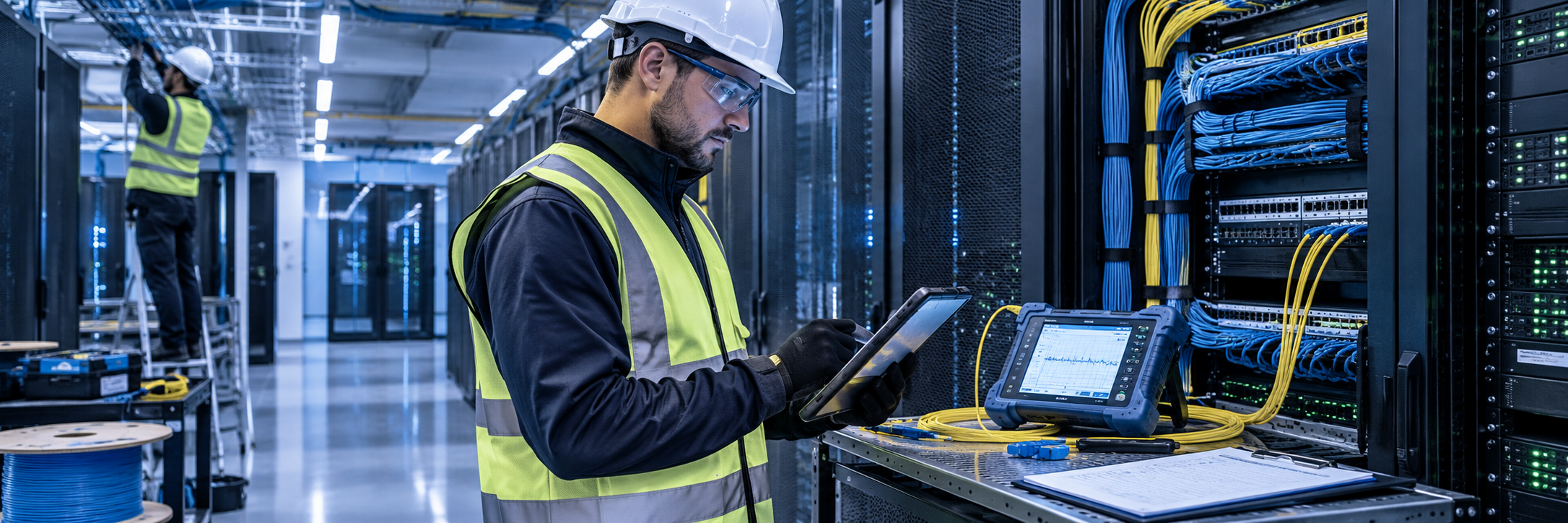
Fibre optic engineers install, terminate, splice, and test fibre optic cable systems. They work across commercial buildings, data centres, telecoms infrastructure, and public sector sites. The work involves reading drawings, managing cable routes, using specialist test equipment, and producing documentation that tells the next person exactly what was installed and how it performed.
Entry routes
There is no single qualification required to start working in fibre optic installation. Most engineers enter through one of three routes.
Coming from a general structured cabling background is the most common path. Engineers who have spent time on copper installation often transition into fibre work as they develop and take on more complex project environments. The skill transfer is real. Cable management, containment, site discipline, and documentation all carry across.
Apprenticeships in telecoms or network infrastructure sometimes include fibre as part of a broader programme. City and Guilds Level 2 and Level 3 qualifications in telecoms and network infrastructure are the relevant framework.
Direct entry with specialist training is less common but available. A small number of training providers offer short intensive courses in fibre installation fundamentals. These are most useful as a foundation for someone coming from a different trades background.
Skills that matter early on
Fibre work requires a different set of physical skills than copper cabling. Terminating fibre connectors and splicing joints demand precision and patience under conditions that are often far from ideal. Tight spaces, poor lighting, and time pressure are the norm, not the exception.
Reading test results accurately is equally important. A fibre optic loss test produces data. Understanding what the data means, what is acceptable, what requires investigation, and what needs to be documented requires training and genuine site experience.
Site discipline matters as much as technical skill. Fibre is fragile compared to copper. Poor handling during installation leads to problems that appear during testing or, worse, after handover. Engineers who treat every metre of cable and every connection with the same care tend to produce work that passes first time.
Certifications worth pursuing
City and Guilds 3667 is the standard entry-level qualification. It covers fibre installation, termination, and testing and is recognised on most commercial and public sector projects.
FOAS (Fibre Optic Accreditation Scheme), run by BSRIA, is the next step for engineers working on projects with higher documentation and quality requirements. It is frequently specified on public sector and healthcare projects.
FOA certifications (CFOT, CFOS) are internationally recognised and carry particular weight in data centre environments where technical standards are set at an international level.
The right time to pursue certifications is once there is real site experience to apply them to. A qualification without the experience behind it carries limited weight.
How fibre work differs from general structured cabling
The stakes are higher. A poorly installed fibre link can affect an entire network path in a way that a poorly installed copper run typically does not. The tolerance for poor terminations or inaccurate test records is much lower.
The equipment is more specialised. OTDRs, power meters, light sources, and fusion splicers are the working toolkit. Fibre engineers need to be genuinely competent with test equipment, not just able to follow a sequence.
The documentation standards are stricter. Test results need link measurements, OTDR traces, and clear identification of every run. Clients and contractors on complex projects depend on this documentation for ongoing maintenance and future upgrades.
What progression looks like
Most fibre engineers start on installation work under supervision, developing splice and termination skills while building site experience. As competence develops, they take on testing responsibilities and progressively work with less direct oversight.
From there, the paths diverge. Some engineers develop deep specialist expertise in data centre fibre, outside plant, or 5G infrastructure. Others move toward site supervision, project coordination, or design roles.
The engineers who progress fastest are those who treat documentation as part of the job from day one, seek out technically demanding projects, and take certifications seriously once they have the experience to make them meaningful.
If fibre engineering is a direction you want to develop, our consultants work across fibre and ICT infrastructure and can help identify where the current demand is.