
Why Documentation Fails: The Five Gaps That Create Problems Years After Installation

Structured cabling documentation is one of the most important parts of an ICT installation, yet it is often the area that causes the most issues later. When drawings, test results, and schedules are incomplete or inaccurate, the problems rarely appear on day one. They show up months or years later when teams attempt moves, adds, changes, upgrades, or fault finding.
This article explains the common gaps that cause documentation to fail and how disciplined practice during installation protects the long term performance and maintainability of any ICT system.
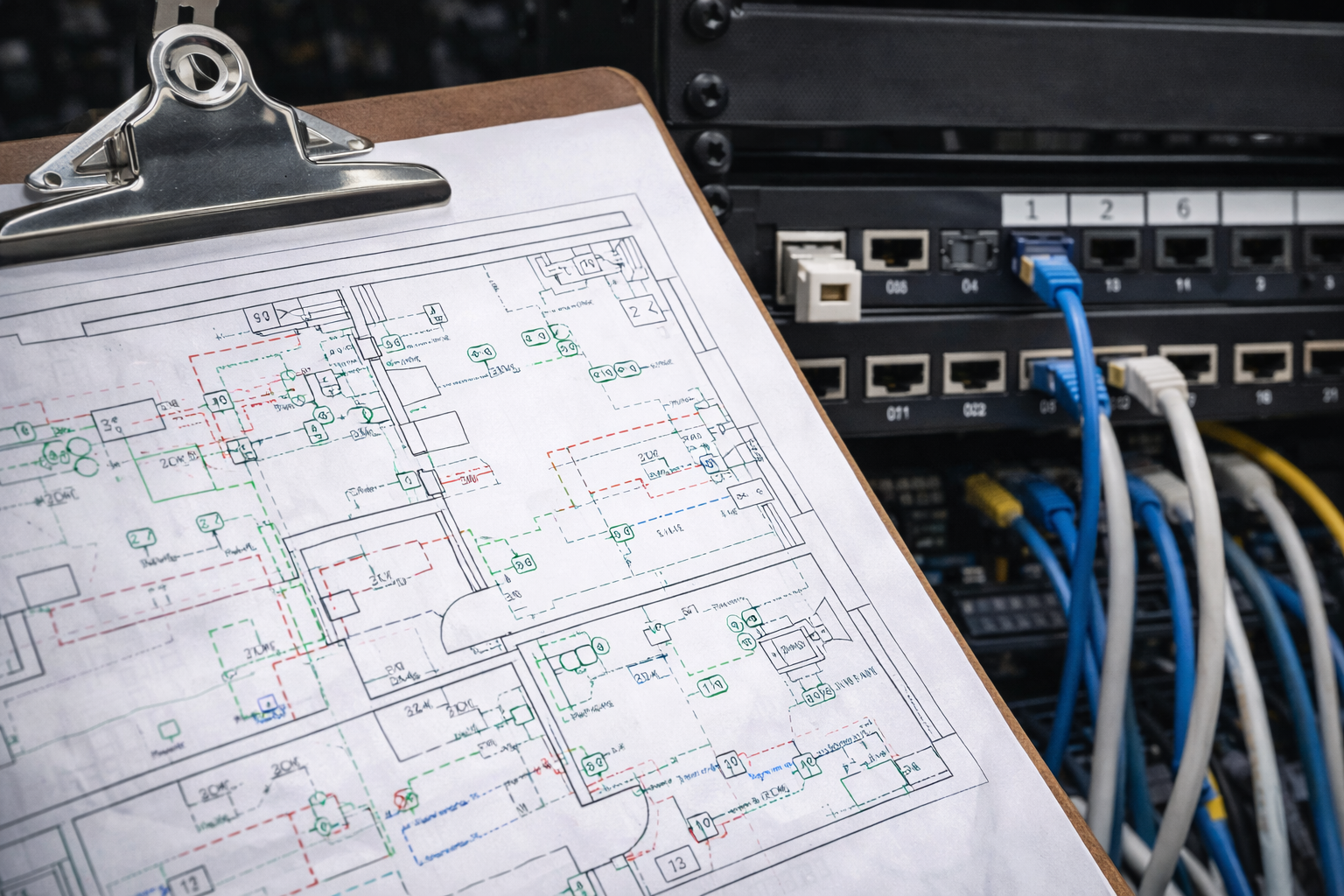
1. Drawings That Do Not Match the Installed Reality
As-built drawings that do not reflect the exact routing, containment, and termination points create confusion for everyone who works on the system later.
Typical issues include:
- Routes that changed during installation but were not updated
- Additional outlets or patch panels added without revision control
- Differences between design intent and practical install decisions
Accurate drawings are not optional. They are the foundation of every modification that follows.
2. Missing or Incomplete Test Results
Test results prove the performance of copper and fibre links. When records are missing or incomplete, future engineers cannot confirm whether a fault is new or inherited.
Common failures include:
- Only pass or fail results with no margin information
- Results stored in multiple places or formats
- Partially tested areas when programme pressure increases
A complete test record protects client warranties and reduces risk during maintenance.
3. Inconsistent Labelling and Asset Identification
Documentation fails when labels, schedules, and rack layouts do not align.
This usually happens when:
- Labelling standards vary between teams
- Patching is not recorded in real time
- Outlet naming does not match the cabinet schedule
When identification is inconsistent, troubleshooting becomes slow and error prone.

4. Lack of Revision Control During Project Changes
Most projects experience design updates, room changes, containment shifts, or scope variations.
Documentation fails when these changes do not follow a controlled update process.
This leads to:
- Multiple versions of drawings in circulation
- Conflicting information between trades
- Handover packs that do not match the final build
Strong revision control ensures the final documentation reflects the final installation.
5. No Clear Owner for Documentation Throughout the Project
One of the biggest reasons documentation breaks down is that responsibility is unclear.
When multiple teams contribute without coordination, gaps appear.
Successful projects define:
- Who updates drawings
- Who maintains schedules
- Who verifies accuracy
- Who compiles the final handover pack
Documentation only works when ownership is continuous from design to completion.
Documentation is not an administrative extra. It is the record of how the system was designed, built, tested, and prepared for long term operation.
When documentation is complete and consistent, it reduces operational risk, improves troubleshooting, and protects the integrity of the installation.

At iCobus, documentation is treated as a core part of quality assurance. Systems that are built well should be documented well, so they remain reliable for years to come.