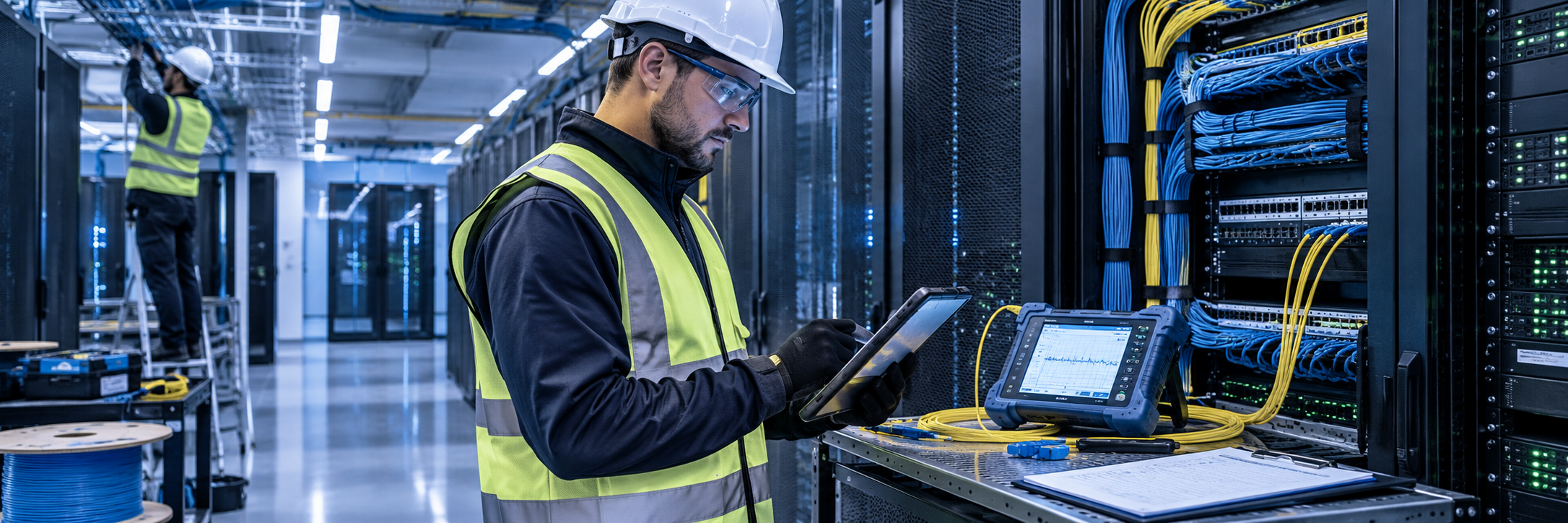
The Skills Powering ICT Infrastructure: What Defines a Modern Cabling Engineer

Every connected system, from offices to data centres, depends on the skill of the people who install and maintain its cabling. The role of the cabling engineer has evolved far beyond pulling cable and crimping connectors. It now blends technical knowledge, safety awareness, and precision workmanship.
Modern ICT environments demand engineers who can think system-wide, work to strict standards, and adapt to new technologies as they emerge.
1. Technical understanding across copper and fibre
Cabling engineers are expected to understand both copper and fibre systems in detail. This includes how each medium behaves, where to use them, and how to terminate, test, and document installations correctly.
Cat6a, OM4, and single-mode fibre are now standard in many projects, and engineers must know how to work with them safely and efficiently.
2. Certification and compliance knowledge
The best engineers work within established frameworks such as ISO/IEC 11801, EN 50173, and BS EN 50600. They understand what compliance means in practice and how to document installations for testing and handover.
Holding ECS or CSCS accreditation is essential for access to most UK sites, while BICSI and manufacturer-specific training further enhance credibility.
3. Attention to safety and site discipline
Working safely is fundamental in ICT infrastructure. Cabling engineers handle tools, lifts, and occasionally electrical equipment. Awareness of risk assessments, method statements, and site-specific safety protocols keeps both the team and the installation protected.
4. Precision and workmanship

Modern data and power systems rely on connections made with millimetre accuracy. Poor terminations, incorrect bend radius, or loose patching can reduce performance and create costly faults. Skilled engineers take pride in the neatness, organisation, and reliability of their work.
5. Adaptability and continuous learning
Technology never stands still. Engineers now work on systems that support PoE, Wi-Fi 7, and smart building automation. Staying current through ongoing training ensures installations meet new power, data, and sustainability demands without compromising safety or performance.
6. Communication and coordination
Cabling engineers rarely work in isolation. They coordinate with project managers, electricians, M&E teams, and IT specialists. Clear communication ensures containment, routing, and scheduling align smoothly across trades.
7. Documentation and testing accuracy
Testing is not the end of the job; it is part of the job. Engineers who can produce complete, accurate test reports and maintain clear labelling help prevent downtime and simplify maintenance. Strong documentation is the mark of professional work.
8. Professional pride and accountability
What separates a capable engineer from a great one is care for the end result. Every rack, tray, and termination reflects the quality of the team behind it. Attention to detail, respect for standards, and ownership of outcomes build both personal and client trust.
Modern cabling engineers are the quiet force behind digital infrastructure. Their skill, training, and precision keep systems performing day after day. As connectivity expands and technology advances, the demand for high-quality engineering will only grow - and with it, the value of those who keep the networks running.