
European Data Centre Capacity Has Nearly Tripled Since 2016 - What It Means for ICT Infrastructure Teams
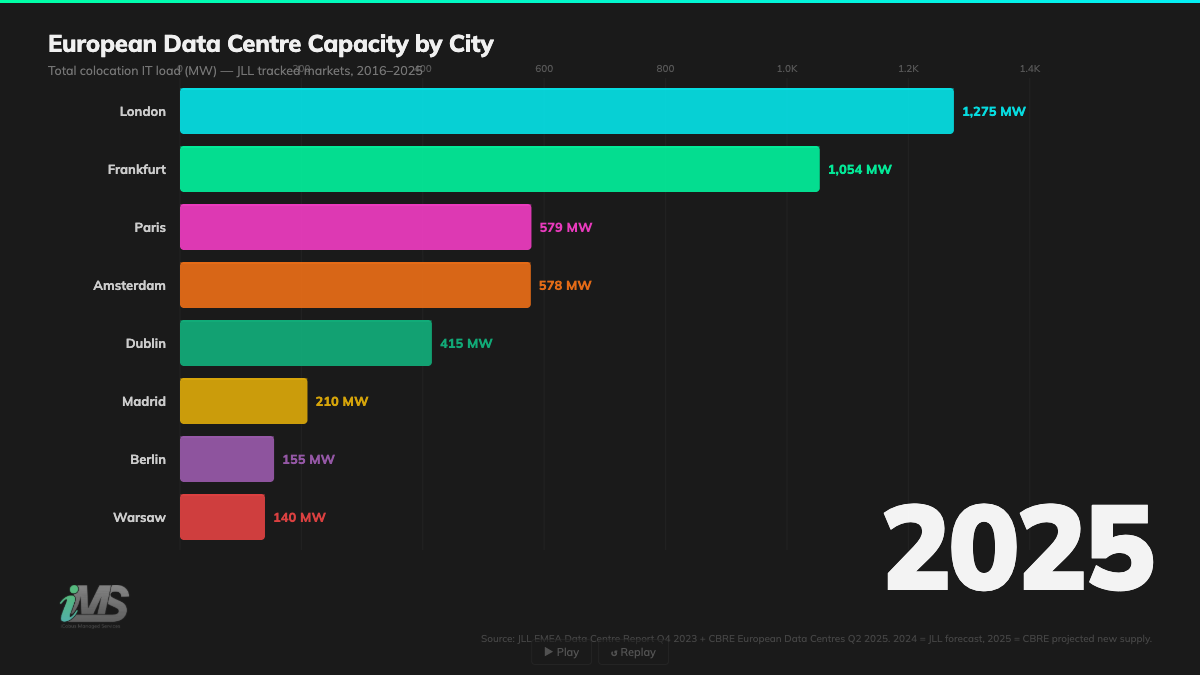
Europe's data centre market is in the middle of its most sustained expansion in history. According to data from JLL's EMEA Data Centre Report and CBRE's European Data Centres research, total colocation IT load across Europe's eight tracked markets grew from approximately 1,294 megawatts (MW) in 2016 to an estimated 4,256 MW by 2025 - a 229% increase in under a decade.
The growth has not been uniform. Some cities have added capacity at a pace that has fundamentally reordered the European rankings, while others have seen their dominance quietly erode. The resulting shifts tell a clear story about where data centre construction is accelerating, where skilled ICT infrastructure teams are most needed, and how the competitive landscape between European hubs is evolving.
The Race for European Data Centre Capacity
The interactive visualization below tracks total colocation IT load across eight European data centre markets from 2016 through 2025. FLAPD markets (Frankfurt, London, Amsterdam, Paris, Dublin) are sourced from JLL's per-market bar charts. Secondary markets (Madrid, Berlin, Warsaw) use JLL 2023 confirmed snapshots with earlier years derived from new supply data.
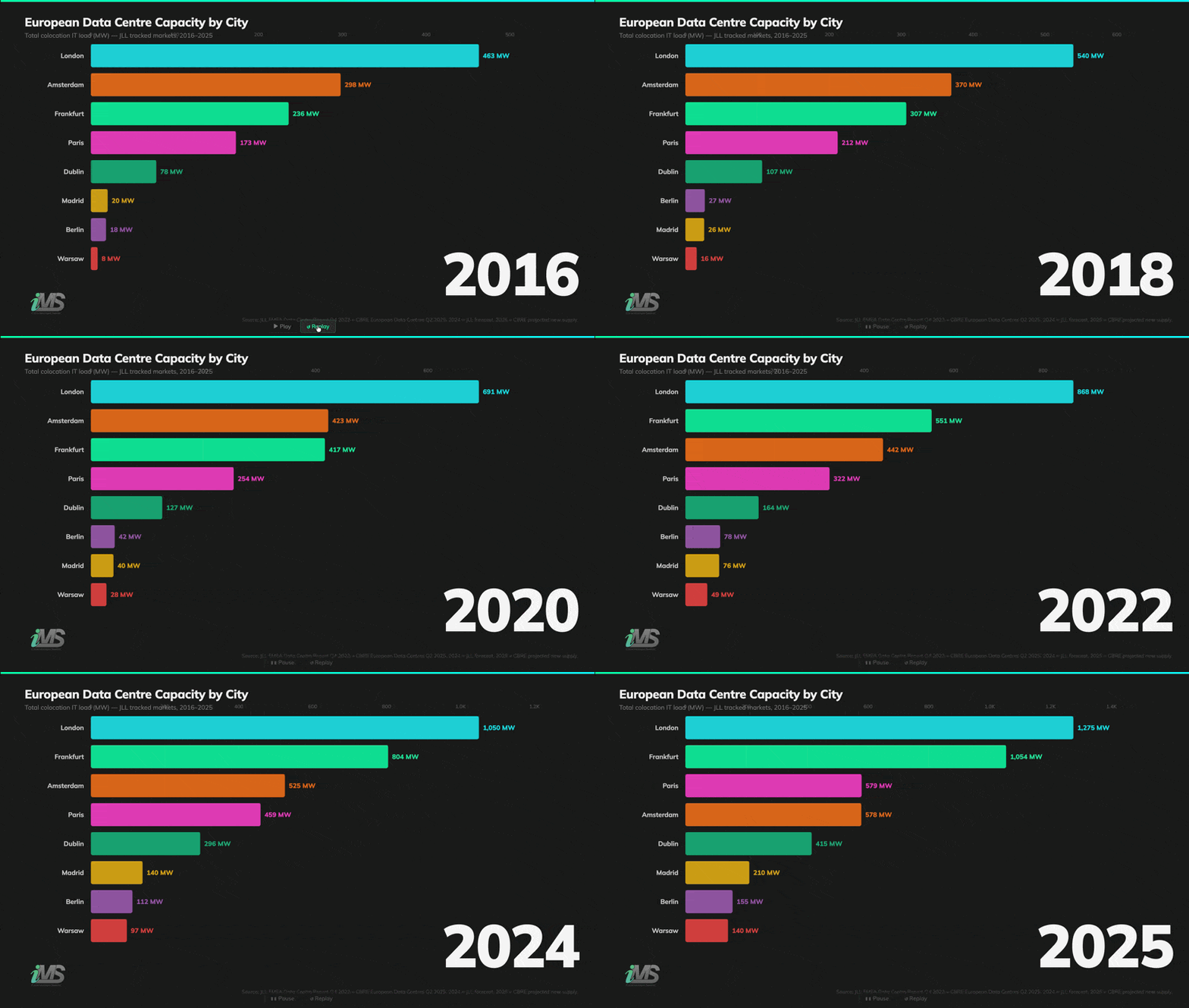
Sources: JLL EMEA Data Centre Report Q4 2023, CBRE European Data Centres Figures Q2 2025. 2024 figures based on JLL forecasts. 2025 figures incorporate CBRE projected new supply.
London Maintains Its Lead - But Frankfurt Is Closing Fast
London has held the top position throughout the entire period, growing from 463 MW in 2016 to an estimated 1,275 MW by 2025. That represents consistent year-on-year expansion, driven by the UK's position as Europe's largest data centre market overall, with an installed capacity of approximately 3.69 GW nationally.
But the story beneath the headline is Frankfurt's relentless climb. Starting at 236 MW in 2016, Frankfurt has grown to an estimated 1,054 MW in 2025 - crossing the 1 GW threshold. That is a compound annual growth rate of approximately 18%, consistently outpacing London's expansion in percentage terms. Frankfurt added an estimated 187 MW of new supply in 2025 alone, compared to London's 171 MW.
Frankfurt's growth is fuelled by its status as mainland Europe's primary interconnection hub. The DE-CIX exchange, Europe's largest internet exchange point, anchors a dense ecosystem of connectivity that continues to attract hyperscale operators and enterprise occupiers. For ICT infrastructure teams, Frankfurt represents a market where structured cabling, fibre optics, and power distribution projects are running at a scale and pace that demands experienced engineers.
Paris Overtakes Amsterdam
One of the most significant shifts visible in the data is Paris surpassing Amsterdam in 2025. Amsterdam held third place for most of the period, benefiting from the Netherlands' early position as a European connectivity hub. But Amsterdam's growth has plateaued - adding just 31 MW of projected new supply in 2025, compared to Paris's 87 MW.
Amsterdam's slowdown is partly policy-driven. The Dutch government introduced a moratorium on new data centre construction in parts of North Holland in 2022, citing concerns over energy consumption and land use. With data centres consuming approximately 6% of national electricity, political pressure has constrained new development in ways that have not affected other FLAPD markets to the same degree.
Paris, by contrast, has accelerated. French government incentives for digital infrastructure, combined with available power capacity and a growing AI-driven demand base, have pushed Paris from 173 MW in 2016 to an estimated 579 MW in 2025. The market added more capacity in 2025 than Amsterdam has added in the past four years combined.
Dublin's Outsized Growth
Dublin's trajectory is remarkable for a city of its size. Growing from 78 MW in 2016 to an estimated 415 MW in 2025, Dublin has established itself as Europe's fifth-largest data centre market by colocation capacity - a position driven almost entirely by hyperscale demand.
Ireland now consumes approximately 18-19% of its national electricity in data centres, the highest proportion of any European country by a significant margin. This has created both extraordinary demand for ICT infrastructure professionals and an increasingly complex regulatory environment. EirGrid's constraints on new grid connections in the Dublin region have not stopped growth, but they have pushed operators toward more innovative power solutions - on-site generation, battery storage, and grid reinforcement projects that require specialist engineering expertise.
For ICT professionals, Dublin represents a market where the complexity of each project is increasing. It is no longer sufficient to install standard cabling and power infrastructure; the engineering challenges around power resilience, cooling efficiency, and grid integration demand teams with deep technical capability.
The Rising Secondary Markets
Madrid, Berlin, and Warsaw represent the next wave of European data centre expansion. All three cities were small markets in 2016 - Madrid at 20 MW, Berlin at 18 MW, Warsaw at just 8 MW - but have grown to 210 MW, 155 MW, and 140 MW respectively by 2025.
Madrid has benefited from submarine cable connectivity (particularly links to Latin America and Africa), making it an increasingly attractive location for operators seeking geographic diversity beyond the traditional FLAPD hubs.
Berlin has grown steadily but remains surprisingly small relative to Germany's overall data centre market. Frankfurt's dominance as a connectivity hub has historically drawn development away from the capital, though Berlin's growing tech sector is beginning to generate local demand.
Warsaw has emerged as Central Europe's primary data centre hub, serving as a gateway between Western European networks and the expanding Eastern European market. Its growth from 8 MW to 140 MW - a seventeen-fold increase - reflects the broader trend of data centre development following fibre network expansion across Central and Eastern Europe.
These secondary markets represent significant opportunity for ICT infrastructure firms. The build-out in these cities is earlier-stage, meaning the demand for foundational work - structured cabling, fibre installation, power distribution, and project management - is intense and growing.
What This Means for ICT Infrastructure Staffing
The data points to several clear implications for the ICT infrastructure workforce across Europe.
Demand for skilled engineers is outstripping supply across every major market. With total tracked capacity growing by over 400 MW per year and secondary markets expanding rapidly, the volume of active construction and fit-out projects requiring experienced cabling, fibre, and electrical engineers is at an all-time high.
Project complexity is increasing. Modern data centre builds are not simple cabling installations. They involve high-density structured cabling (Cat 6a and above), fibre optic networks with demanding performance specifications, advanced cooling systems, and increasingly sophisticated power distribution architectures. The trend toward liquid cooling for AI workloads is adding yet another layer of specialist engineering requirement.
Geographic mobility creates career opportunities. Engineers willing to work across multiple European markets - particularly the fast-growing secondary hubs in Madrid, Warsaw, and Berlin - are in a strong competitive position. The expansion of data centre construction into new regions means that experienced ICT professionals can command premium rates in markets where local talent pools have not yet caught up with demand.
The pipeline extends years into the future. Hyperscale operators are committing to capacity three to five years ahead of delivery. The FLAPD aggregate grew at a 17% CAGR from 2018 to 2023, and secondary markets grew even faster at 23%. With AI-driven demand accelerating rather than slowing, the construction pipeline for European data centres is longer and larger than at any point in the industry's history.
Delivering the Teams Behind Europe's Data Centre Expansion
European data centre capacity has nearly tripled in under a decade, and the pace of expansion shows no sign of slowing. The shift in rankings - Frankfurt closing on London, Paris overtaking Amsterdam, Dublin punching well above its weight, and secondary markets emerging as significant hubs - reflects a market that is both growing rapidly and becoming more geographically distributed.
For companies managing data centre construction and fit-out projects across the UK and Europe, securing the right ICT infrastructure teams is a critical challenge. iCobus specialises in exactly this space - providing experienced structured cabling engineers, fibre optic specialists, and ICT project teams through a three-level service model that covers recruitment, subcontracting, and full managed services delivery.
With 25 years of experience in ICT infrastructure and a deep understanding of the technical requirements that data centre projects demand, iCobus delivers teams that operate at subcontractor-level expertise - not just bodies on site.
To discuss your data centre staffing requirements, get in touch with iCobus. For the latest insights on ICT infrastructure, data centre developments, and industry trends, follow iCobus on LinkedIn.
Sources
· JLL, EMEA Data Centre Report Q4 2023, 2024
· CBRE, European Data Centres Figures Q2 2025, September 2025
· Roland Berger, State of the European Data Centre Market, 2024
· JRC, Energy Consumption in Data Centres and Data Transmission Networks in the EU (JRC135926), 2023